
Sales Handoff Process: A Step-by-Step Guide for B2B Teams

A sales handoff process is the agreed way ownership of a lead moves from one person or team to the next: who triggers it, what context travels, who accepts it, and what happens by when. It breaks most often at the first link, where a lead that was never really interested lands on an account executive’s list. That is why the strongest handoffs start with leads that carry written proof of interest, such as a reply asking for a meeting or pricing. This guide gives you the full routine, from marketing to SDR to AE, with a checklist you can copy into your CRM.
TL;DR
- A handoff needs five parts: a trigger, a mandatory data packet, a named owner, an acceptance or return rule, and a response deadline.
- Define qualification as observable evidence (a request, a reply, a meeting booked), not as activity or a score alone.
- Until the receiver accepts a lead, the sender stays responsible for it, so no lead is ever ownerless.
- Measure acceptance rate, time to first action and return reasons, then review recent handoffs and tighten the standard.
- Starting from leads that already asked for a meeting or pricing removes the biggest source of rejected handoffs. AIViral delivers exactly that.
Table of Contents
- What a sales handoff is, and where it happens
- Step 1: Define what a qualified lead is
- Step 2: Set the trigger and the response deadline
- Step 3: Build the handoff packet
- Step 4: Assign an owner and require acceptance
- Step 5: Run the CRM side cleanly
- Step 6: Measure and improve the handoff
- The last handoff: sales to customer success
- Why the handoff gets easier when the lead is already interested
- What AIViral delivers, and what it costs
- A one-page handoff checklist
- FAQ
- Sources
What a sales handoff is, and where it happens
A handoff is a structured transfer of a lead, deal or account, including the important information, the buyer’s expectations and the next step (Scratchpad). In a B2B team it usually happens at three points:
- Marketing or outbound to SDR. A lead shows interest and someone has to pick it up.
- SDR to account executive (AE). An SDR (sales development rep, the person who qualifies new leads) passes a qualified prospect to the AE who runs the deal and closes it.
- AE to customer success or implementation. The deal is won and the customer needs onboarding.
This article focuses on the first two, because that is where agencies, consultants and SaaS sales teams lose the most pipeline. The third gets a short checklist near the end.
The cost of a bad handoff is concrete. Buyers repeat their story, trust erodes, deals slow down, and your team spends time reconstructing what someone already knew (Scratchpad). Analyst firm Gartner has also argued that B2B buying is not a straight line: buyers loop back through validation and consensus, so sales and marketing should help them complete the purchase together rather than throw leads over a wall (Gartner). Treat the handoff as a shared moment, not a one-way drop.
Step 1: Define what a qualified lead is
Most handoff arguments are really arguments about definitions. Marketing says a lead is ready; sales says it is not. Fix this first, in writing.
Use evidence anyone can see in the record, not opinions. A workable standard has four parts: a relevant organization, a plausible use case, a verified request or expression of intent, and enough contact information to act on it (NBT Digital). The same guide separates account fit from activity. A contact at an ideal-fit company who downloaded one guide may not be ready to buy, while a very active contact outside your serviceable segment may never be a good customer. You need both signals, and you should record them separately.
A few practical rules:
- Name the exceptions. Existing customers, partners, competitors, students and duplicate inquiries should be excluded or routed elsewhere on purpose.
- Pick a framework and stick to it. If you want a structured way to judge needs, budget, authority and timing, our guide to lead qualification frameworks like BANT, CHAMP and MEDDIC compares them.
- Keep scoring honest. A score is a sorting tool, not proof of interest. See how to build a lead scoring model sales actually trusts.
- Separate MQL from SQL. A marketing-qualified lead has shown engagement; a sales-qualified lead has been vetted by a person. Our piece on MQL vs SQL and sales-accepted handoff rules shows where the line belongs.
If your leads come from content downloads or syndication, expect more sorting work before handoff. A demand-gen playbook for B2B content syndication explains how that channel feeds the top of the funnel, which is useful when you decide how much qualification must happen before sales sees a lead.
Step 2: Set the trigger and the response deadline
The trigger is the event that starts the transfer. Make it a single, checkable event: a reply asking for pricing, a booked discovery call, a demo request. For an SDR-to-AE transfer, a common pattern is a completed discovery call, basic qualification and a scheduled next meeting, with a transfer window of about 24 hours (LeanB2BTools). Treat that as an example to adapt, not a universal benchmark; the source itself frames it that way.
Then set a service-level agreement (SLA), meaning a promised response time. A good one includes:
- the event that starts the clock;
- clock rules (business hours, time zones, weekends);
- the escalation path if nobody acts;
- a distinction between a first attempted contact and a completed conversation.
Response expectations should reflect intent. Someone who asked for pricing deserves a faster reply than someone who opened a newsletter. Xengrowth’s SLA cookbook suggests an escalation sequence: notify the owner, then the manager, then reassign if there is no activity by the deadline, and it stresses that response-time targets are company-specific starting points, not industry norms (Xengrowth). Start with a target you can meet, then tighten it.
Step 3: Build the handoff packet
The packet is the context that travels with the lead. If the receiver has to ask the buyer to repeat anything, the packet was too thin.
Marketing or outbound to SDR
Record these fields in the CRM, which should be the single source of truth:
- Who the person is and the original inquiry or reply, word for word
- Source and campaign
- Qualification evidence (what proves interest, and when)
- Contact history and any promises made
- Contact permissions that apply
- A specific next action with a due time
- Open issues or dependencies
This follows the practical packet described by OpSmith’s lead handoff checklist, and HubSpot makes the same point about keeping the CRM as the source of truth in its SDR workflow guidance.
SDR to AE
Add what the AE needs to run a real second conversation: evidence the discovery meeting happened, the buyer’s problem, timeline, the contact’s buying role and the agreed next step. Other stakeholders and competitors mentioned belong in a context section beyond the minimum (MartechDevs checklist). Link the buying contact to the opportunity so nothing lives only in an SDR’s notebook.
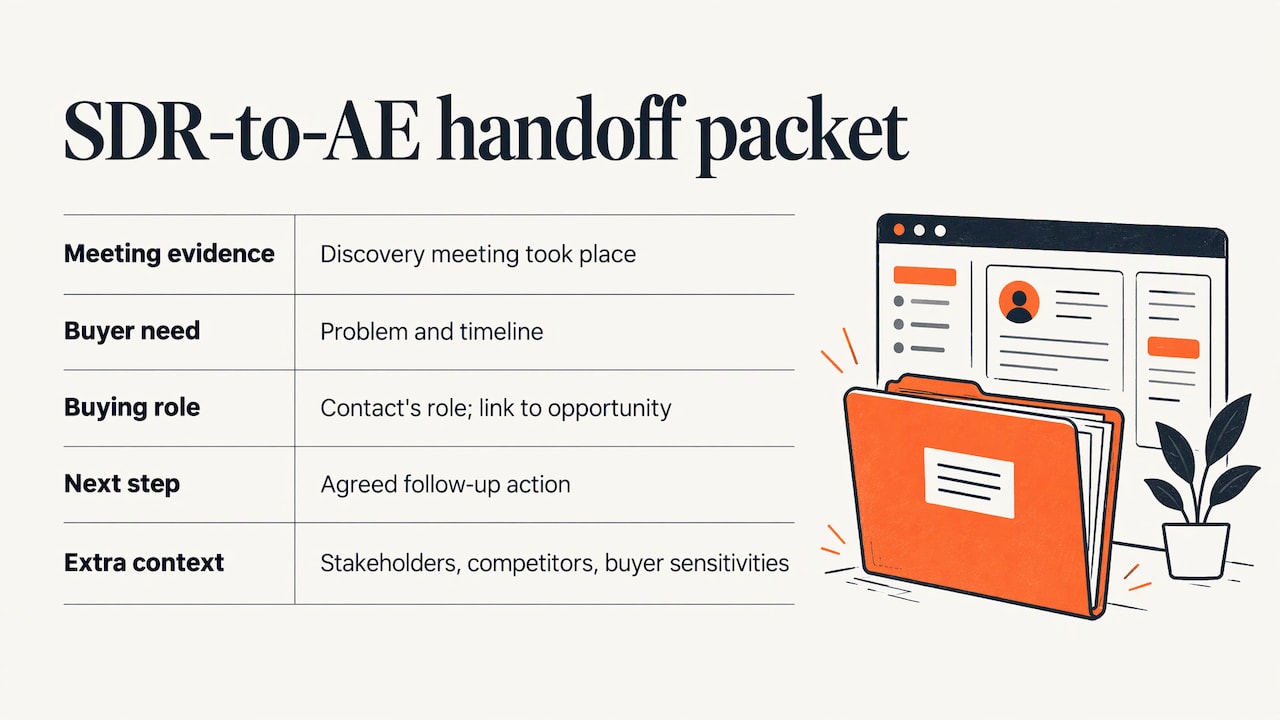
One point from PostHog’s public handbook is worth adopting: relationship and political context, such as who the champion is, how the buyer likes to communicate and what is sensitive, often does not fit in CRM fields, so write it down anyway when it matters (PostHog handbook).
A quick example
Imagine a prospect replies to an outbound email: “Can you send pricing and set up a call next week?” A weak handoff says “interested, follow up.” A strong one logs the reply text, the company size and role, the stated need, the proposed week for the call, and the owner with a due time of the same business day. The AE opens the record and already knows what to say.
Step 4: Assign an owner and require acceptance
Assignment is not acceptance. A lead that sits in someone’s queue unread is still effectively unowned. Build two rules:
Routing. Check for an existing account owner first. Then consider market, language, product, segment and capacity, with a monitored fallback owner and written reassignment rules (Marketing Ops Manager). For deeper patterns, see our lead routing best practices.
Acceptance or return. The receiver either accepts the lead or returns it with a structured reason: missing information, wrong specialist, duplicate inquiry, no capacity. OpSmith frames returns as quality control rather than rejection, since the reasons show exactly where the packet or the routing fails. While acceptance is pending, the sender remains responsible for the response promise and any open tasks, so the buyer never falls into a gap (OpSmith).
To see how acceptance data exposes weak spots, read our breakdown of sales accepted lead intake metrics.
Step 5: Run the CRM side cleanly
A CRM lead handoff is only as good as what gets logged. For each lead, capture:
| Field | Why it matters |
|---|---|
| Lead source | Shows which channels produce accepted leads |
| Qualification time | Starts the SLA clock |
| Assigned owner and time | Proves who was responsible when |
| First logged sales activity | Measures real response time |
| Accept or return time and reason | Feeds quality control |
| Opportunity created | Ties the handoff to pipeline |
These are the fields the Marketing Ops Manager checklist recommends tracking. For capture, qualification and closing mechanics, our CRM lead management guide walks through the full flow.
Keep fields mandatory at the trigger stage. If a rep cannot move a lead forward without the reply text, the source and the next action, your data stays complete without nagging.
Step 6: Measure and improve the handoff
A handoff you never review decays. Watch a short list of numbers:
- acceptance rate and time from assignment to acceptance;
- returns for missing information, and the reasons;
- time from qualification to first action, by owner and source;
- SLA attainment and currently overdue leads;
- stage conversion and time in stage;
- meeting show rate after an SDR-to-AE transfer.
Xengrowth’s cookbook lists most of these (Xengrowth), and Pedowitz Group adds routing accuracy, leakage and data completeness as governance measures (Pedowitz Group).
Once a month, pull five recent handoffs and read them as the AE would. Ask what was missing, what the buyer had to repeat, and what the return reasons say. Update the standard, not the people. If your pipeline contains scored leads, a practical lead scoring scorecard shows one way to check whether scores line up with what sales accepts.
Common failure causes to look for: different qualification definitions between teams, ownership changes without explicit acceptance, notes in private documents, vague buyer commitments, no scheduled next meeting, and stale CRM fields.
The last handoff: sales to customer success
When a deal closes, the packet changes. Include the customer’s goals and success criteria, stakeholder roles, commitments made during the sale, technical requirements and integrations, contract start and renewal dates, notice deadline, billing setup status and the named customer success owner (MartechDevs checklist). Add the customer’s current tools and process, the reasons they bought and how they will measure success, and introduce the account manager early (Process Street).
Why the handoff gets easier when the lead is already interested
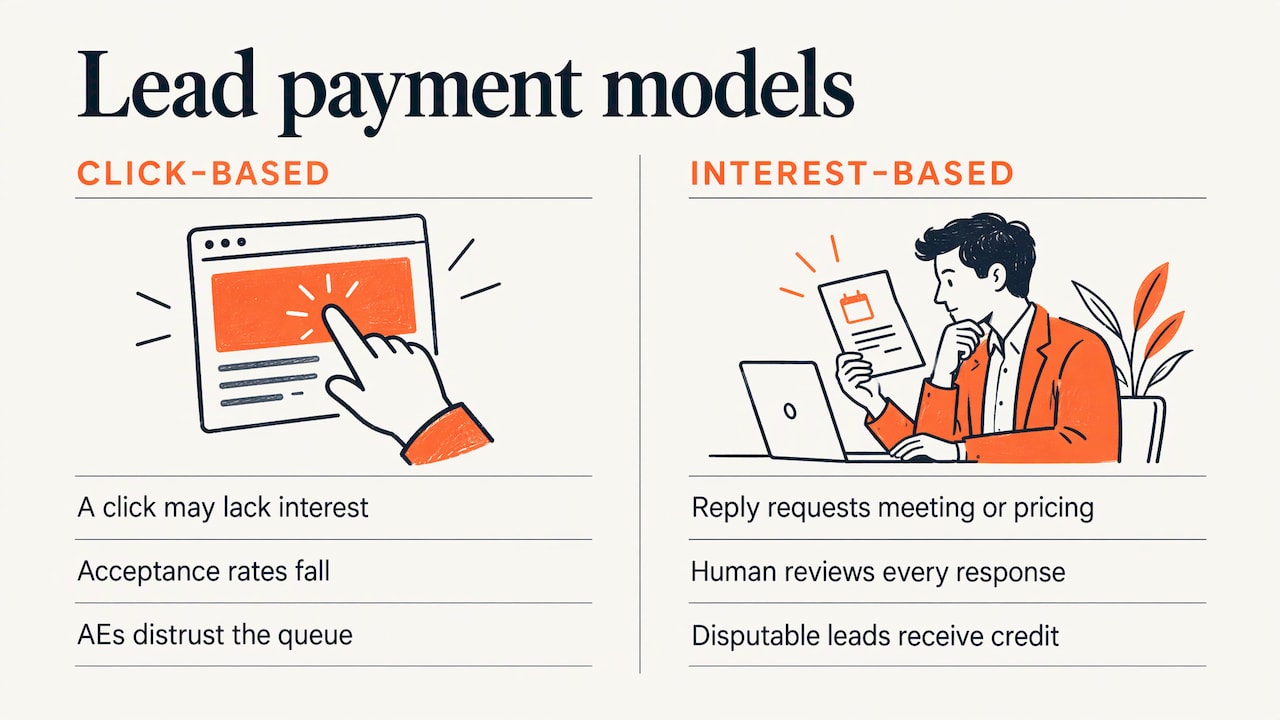
Every step above is cheaper when the lead arriving at step one is real. If your SDRs spend their days chasing leads who clicked an ad and never wanted a conversation, acceptance rates fall, returns pile up and AEs stop trusting the queue. A handoff standard cannot fix a lead that was never interested.
This is the problem we built AIViral around. We run cold email, LinkedIn, social outreach and search ads ourselves, verify replies from decision-makers in real time, and deliver only leads who asked for a meeting, a call, pricing, info or a demo. A human reviews every response before you are charged. Your handoff trigger, a reply showing clear interest, is already met when the lead reaches your dashboard.
We have watched the handoff conversation from the outbound side for a long time, and the fix people reach for first is a better form or a longer checklist. We think the fix starts earlier: pay for the moment a prospect says yes, not for the click that might lead to it.
When the only leads that reach your team are ones who replied asking for a meeting or pricing, qualification disputes shrink. Marketing cannot over-claim readiness, and sales cannot dismiss a lead that arrives with a written request attached. Our model charges only when a prospect shows genuine interest, a human reviews each response first, and if a lead does not meet the interest standard, you can dispute it and receive credit. We operate and fund the outreach and the ad spend, so you are not carrying that risk while your process matures.
A good handoff process and a good lead source work together. Build the first, and let us supply the second.
Max
What AIViral delivers, and what it costs
Our pricing is per lead, with no setup fees and no contracts, and it scales with the strength of the interest shown:
| Tier | Price per lead |
|---|---|
| Warm | $5 to $15 |
| Hot | $15 to $30 |
| On fire | $30 to $50 |
You pay only for qualified, interest-verified leads, with no retainers or ad spend billed to you. If you want to see how that compares with your current cost per lead, use our cost per lead calculator, read how pay per lead works or see the full pricing and how it works.

If your team already has a handoff checklist and needs interested prospects to feed it, start with AIViral and get leads who have already asked to talk. For the channels behind them, see our guides to cold email lead generation and LinkedIn lead generation, and for pairing signals with sales moves, intent data for B2B.
A one-page handoff checklist
Copy this into your CRM or playbook:
- Qualification standard written and agreed by marketing and sales.
- Single trigger event defined (reply, booked call, demo request).
- Mandatory fields: identity, original inquiry, source, qualification evidence, contact history, next action with due time.
- Routing order: existing owner, then segment, language, product, capacity, then fallback.
- SLA with clock rules and escalation to manager, then reassignment.
- Acceptance or structured return reason required.
- Sender stays responsible until acceptance.
- Monthly review of acceptance rate, time to first action and return reasons.
FAQ
What is the difference between a lead handoff and a sales handoff?
A lead handoff moves a new inquiry from marketing or outbound to a sales rep. A sales handoff is the broader term and also covers SDR to AE and AE to customer success. The same principles apply to each: a trigger, a packet, an owner and acceptance.
What should an SDR to AE handoff include?
Include proof the discovery meeting happened, the buyer’s problem, timeline, buying role, the agreed next step and the buying contact linked to the opportunity. Add other stakeholders and competitors mentioned as context. The AE should never need to repeat discovery questions.
How fast should a lead be followed up after handoff?
There is no universal number. Set a target your team can meet, tie it to the buyer’s intent (a pricing request is more urgent than a newsletter click), and define an escalation path. Many teams start with a same-business-day target and tighten from there.
Who owns a lead while the handoff is pending?
The sender. Until the receiver accepts, the sender remains responsible for the response promise and open tasks. This keeps every inquiry owned, even during reassignments.
Sources
- Scratchpad: Sales Handoffs
- Gartner: the marketing-to-sales handoff should no longer exist
- NBT Digital: B2B sales and marketing handoff
- LeanB2BTools: sales handoff for B2B teams
- Xengrowth: marketing-to-sales handoff SLA cookbook
- OpSmith: sales lead handoff checklist
- HubSpot: SDR workflow
- MartechDevs: handoff packet checklist
- PostHog handbook: account allocation and handover
- Marketing Ops Manager: handoff checklist
- Pedowitz Group: well-designed handoff process
- Process Street: sales to service handoff
- Storyline Pros: B2B content syndication
- Advisor lead scoring scorecard