
Search Ads Leads: How B2B Teams Turn Clicks Into Sales Conversations

Search ads put your offer in front of people who are already typing a problem into Google. That is why they are the first channel many B2B teams try, and also why the bill surprises them: you pay for the click, and a click is not a lead, let alone a conversation with a decision-maker. If you want leads from search ads, you have two routes. You can build and tune the campaigns yourself and carry the ad spend and the risk, or you can buy the outcome: prospects who have replied and asked for a meeting or pricing. We built AIViral for the second route, and the rest of this guide explains how search ads work, where the lead quality leaks out, and how to decide.
TL;DR
- Search ads reach people actively searching for what you sell, but you pay per click whether or not the visitor ever becomes a sales conversation.
- Lead quality depends on keyword intent, tight ad-to-landing-page match, qualifying questions and feeding real sales outcomes back to Google.
- Judge a campaign by cost per qualified lead and meetings booked, not by clicks, form fills or cost per lead alone.
- AIViral runs and funds the outreach, including search ads, and charges $5 to $50 per lead, only when a prospect shows genuine interest.
- A pay-per-lead model moves the click-and-conversion risk from your budget to ours.
Table of Contents
- What search ads are and why B2B teams use them
- Where search ad lead quality leaks
- How to set up search ads for qualified leads
- Which numbers tell you the leads are real
- The hidden cost of running search ads yourself
- What if you paid only for interested prospects?
- Perspective
- Pricing: what a lead costs with AIViral
- Promo: get leads who already asked to talk
- Who this approach fits
- FAQ
- Sources
What search ads are and why B2B teams use them
A search campaign shows your ads in Google’s results to people searching for products and services related to the keywords you choose. According to Google Ads Help, these campaigns can drive sales, leads or website traffic, require at least one conversion goal, and can include lead form assets that let a person submit contact details directly in the ad.
For B2B this matters because intent is visible. Someone searching for a product category or a vendor comparison is further along than someone scrolling a feed. Google’s own B2B funnel guidance describes search ads as attracting high-intent traffic and generating leads and smaller engagements such as downloads, case-study views and newsletter signups that can later be nurtured into sales. It lists conversion tracking, Keyword Planner and audience targeting, including company-level targeting, as the main tools for refining B2B campaigns.
The catch is the word “lead.” In a search campaign a lead is whatever conversion you defined: a form submission, a download, a phone tap. Some of those are buyers. Many are students, competitors, job seekers or vendors pitching you back. The platform counts them all the same unless you teach it otherwise.
Where search ad lead quality leaks
Most wasted budget in B2B search disappears in four places.
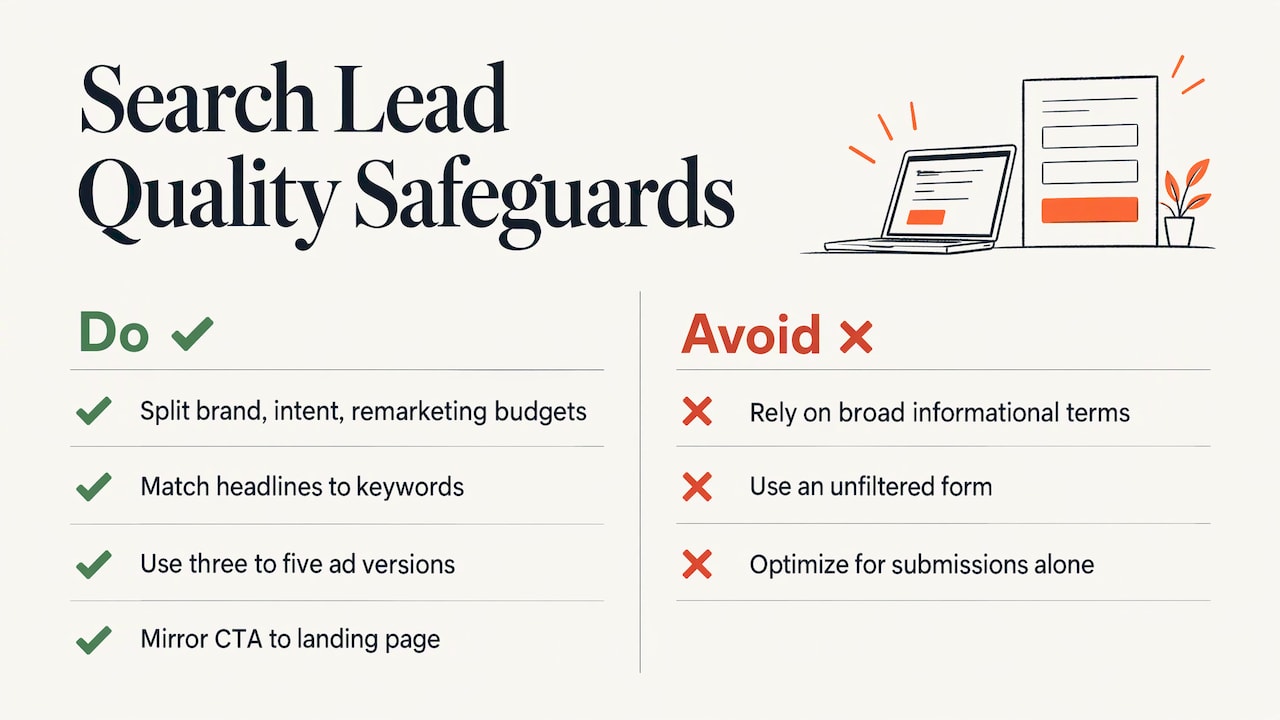
Keyword intent. Broad, informational terms bring research traffic. Search Engine Land’s Mark Meyerson recommends a basic structure of brand terms, high-intent keywords and remarketing, each with its own budget, and using purchase-intent words such as “best,” “compare,” “cheapest” or “sale” to signal decision-ready searchers. Keeping brand, high-intent and remarketing budgets separate stops cheap brand clicks from hiding poor performance elsewhere.
Ad-to-page match. Google’s guidance on optimizing ads and landing pages says to match headlines closely to keywords, group keywords into tightly themed ad groups, run three to five ad versions per group, and use a specific call to action that mirrors the landing page. The landing page should match the ad and keyword, work on mobile, be easy to navigate and carry useful, unique content.
The form. A short form lifts submissions and lowers quality at the same time. A form with no filter lets anyone through.
The feedback loop. If Google only hears “a form was submitted,” it optimizes toward more form submissions, not more buyers.
How to set up search ads for qualified leads
If you run the campaigns yourself, this is the routine that moves quality the most. At each step we note where it usually goes wrong.
1. Build keyword groups around the buying problem
Start from what a buyer types when they have the problem you solve, and from comparison and category terms. Use Keyword Planner to see volume and then split keywords into small themes so each ad speaks to one need. Where it goes wrong: stuffing many themes into one ad group, which forces generic ad copy and attracts mixed intent.
2. Write the ad and the page as one message
The promise in the headline has to be the first thing on the page. If the ad says “pricing for fleet software,” the visitor should land on a page about fleet software pricing, not your home page. For practical ways to improve that click-to-form path, see this guide to optimizing landing pages. Where it goes wrong: sending every ad to the same page.
3. Add qualifying questions to the lead form
Google offers qualifying responses for lead forms in Search campaigns. You mark which answers indicate a good fit, keep the qualifying questions mandatory, and base them on budget or plan fit, timing, or role and authority, as described by one Google Ads practitioner guide. The response-qualified conversion action is added to the Qualified lead goal. Where it goes wrong: making every answer “qualifying,” which defeats the filter.
4. Bid toward qualified leads, not raw submissions
Google’s lead quality best practices advise mapping the lead journey and bidding toward lead-specific goals such as qualified lead, converted lead, book appointment or request quote. The conversion action should have at least 15 conversions in the last 30 days at the account level, ideally occur within 7 days of the ad interaction, and have its data uploaded regularly, ideally daily. The same page recommends target cost-per-acquisition bidding for qualified or converted leads when you cannot assign distinct values to each conversion, plus placement and brand exclusions and verification such as ReCAPTCHA, double opt-in or server-side validation.
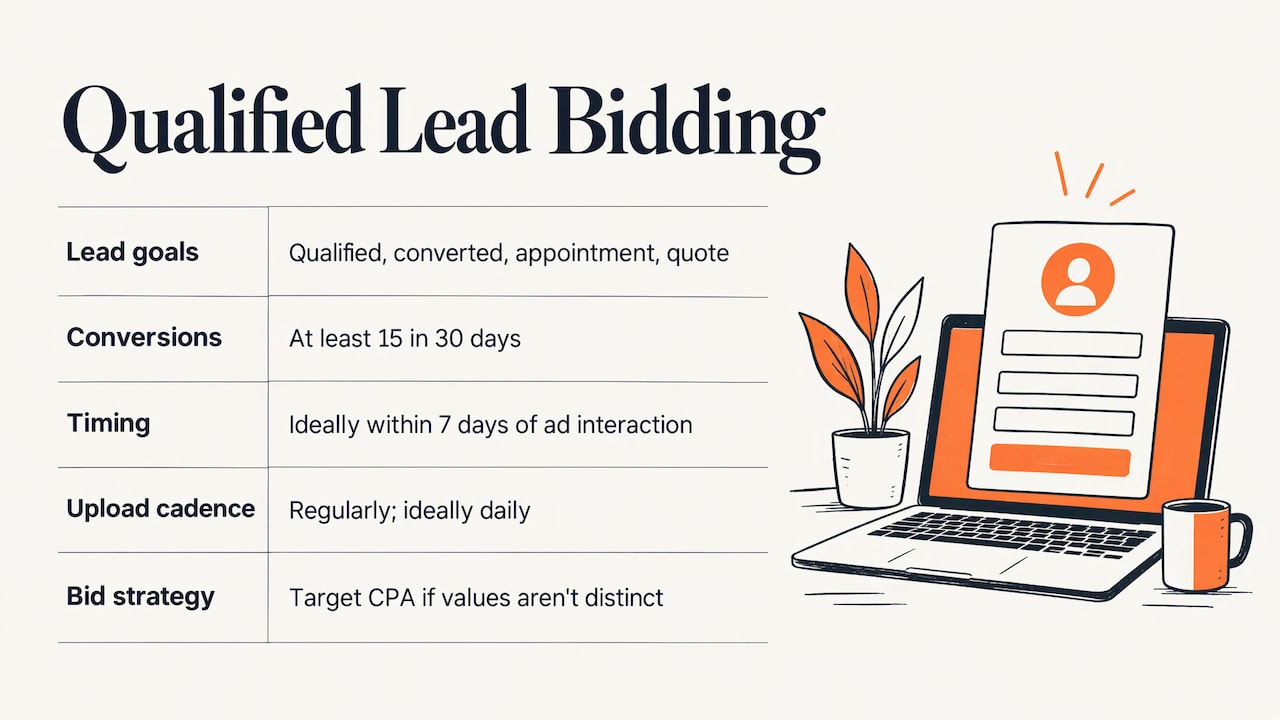
That 15-conversions threshold is the hard part for many B2B accounts. A niche product with a long sales cycle may produce a handful of real opportunities a month, which is too little for the bidding system to learn from.
5. Import what happened after the form
The signal Google needs lives in your CRM: this lead became a meeting, that one became a proposal. Google’s help center on offline conversion import explains how to send those outcomes back, and notes that lead-gen advertisers measuring offline goals should use qualified or converted lead goals. It also says uploads are moving to the Data Manager API from June 15, 2026, so check the current setup instructions before building anything. Where it goes wrong: someone has to match records and upload them consistently, and in most teams that someone is nobody.
6. Review the search terms and prune
Every week or two, read the actual queries that triggered your ads and add negatives for the irrelevant ones. This is routine work, and it is the reason search ads reward a dedicated operator.
Which numbers tell you the leads are real
Clicks, impressions and click-through rate describe the ad. They say nothing about the buyer. For a B2B team the numbers that matter sit further down the funnel:
| Metric | What it tells you | How to calculate it |
|---|---|---|
| Cost per lead | Cheap or expensive form fills | Ad spend / form submissions |
| Qualified lead rate | How many submissions match your ideal customer | Qualified leads / all leads |
| Cost per qualified lead | The real price of a prospect worth calling | Ad spend / qualified leads |
| Meeting rate | Whether leads turn into conversations | Meetings booked / qualified leads |
| Cost per meeting | What each sales conversation costs you | Total spend / meetings held |
| Pipeline per dollar | Whether the channel pays back | Opportunity value / total spend |
Cost per lead looks good on a dashboard and misleads. A campaign with a low cost per lead and a tiny qualified rate can cost more per meeting than a campaign with expensive but well-filtered leads. Our guide to lead quality versus quantity walks through that decision, and our cost per lead calculator lets you run your own spend and conversion numbers. For channel-by-channel context, see our cost per lead benchmarks.
Budget is the other half of the question. Search ads are priced per click through an auction, so cost per lead depends on competition for your keywords, your conversion rate and your quality scores. B2B categories with expensive clicks and low volume are the hardest to run profitably, because every wasted click is costly and the conversion data stays thin.
The hidden cost of running search ads yourself
The media budget is only the visible part. Doing it in-house means someone owns keyword research, ad copy, landing pages, forms, conversion tracking, CRM imports, negative keywords and weekly reporting. Agencies take on that work for a retainer or a percentage of spend. In both cases you fund the ad spend first and learn later whether it produced anything.
That is the structural problem with pay-per-click for a B2B company that wants sales conversations: the risk sits entirely with you. Our comparison of AIViral and Google Ads lays out that difference, and our overview of B2B lead generation pricing shows what each model costs.
What if you paid only for interested prospects?
Pay per lead flips the arrangement. Instead of buying traffic and hoping a share converts, you pay when a prospect has actually raised their hand. Our pay per lead model guide explains how it works and what it costs.
With AIViral, search ads are one channel among several. We handle cold email, LinkedIn, social outreach and search ads, verify replies from decision-makers in real time, and deliver only pre-qualified leads who requested a meeting, call, pricing, info or a demo. We operate and fund all the outreach and ad spend. You pay no setup fees, retainers or ad spend, and you are not tied to a contract.
For a team that wants the intent signal of search without owning the campaign machinery, that is the shorter path. If you are also weighing social channels, our piece on LinkedIn lead generation for B2B covers what works there.
Perspective
Most B2B teams we talk to do not have a traffic problem. They have a conversation problem. A search campaign can report hundreds of clicks and a dozen form fills while the sales team still has an empty calendar.
Our view is that the thing worth paying for is the moment a decision-maker replies and says yes to a meeting or asks for pricing. That is why we only charge when that happens, and why a human reviews every response before it reaches your dashboard. If a lead does not meet the interest standard, you can dispute it and get credit.
Search ads are a good source of intent, and we use them alongside email, LinkedIn and social outreach so the prospect can be reached where they respond. You get the conversation, and we carry the campaign cost until you do.
Max
Pricing: what a lead costs with AIViral
Pricing depends on how strong the prospect’s interest is. Each price is one-off per lead, as published on our site.
| Tier | Price per lead | Billing |
|---|---|---|
| Warm | $5 to $15 | One-off per lead |
| Hot | $15 to $30 | One-off per lead |
| On fire | $30 to $50 | One-off per lead |
There are no recurring fees, retainers or ad spend on your side. Compare these numbers with your own cost per qualified lead from the table above: if your search campaigns spend more per meeting than a Hot lead costs, the arithmetic is worth a second look.
Promo: get leads who already asked to talk
If you want search-intent prospects without building and funding the campaigns, AIViral delivers pre-qualified leads to your dashboard, and you pay from $5 to $50 per lead only when a prospect shows genuine interest. Every response gets a human review before it is charged. See the tiers and how it works on our pricing section.

You can also read how pay per lead, done properly works in detail.
Who this approach fits
- B2B companies that need sales conversations with decision-makers and would rather not fund an experiment first.
- Agencies that want to add clients and need prospects who have already asked for information.
- Consultants looking for discovery calls rather than website traffic.
- SaaS providers that need prospects who requested a demo or pricing.
It is built for B2B. If you sell to consumers, or you want bulk contact data without any interest check, it is not the right model.
FAQ
What are search ads leads?
They are contacts generated when someone searching on Google clicks your ad and completes a conversion action, such as submitting a form or requesting a quote. The quality varies a lot, so B2B teams usually define a stricter “qualified lead” goal, which Google supports for lead campaigns.
Do search ads work for B2B?
They can, because ads appear when a buyer searches for a product or service like yours, which signals intent. Results depend on keyword choice, landing page match, form design and whether you feed real sales outcomes back into your bidding. Long sales cycles and thin conversion volume make the optimization harder.
How do I know if a search ad lead is qualified?
Check fit against budget, timing, and role or authority, which are the criteria Google’s qualifying questions are built around. Then track what share of leads become meetings and what you pay per meeting. A lead who has asked for a meeting or pricing has already shown interest, which is the standard we apply before charging.
How much does a lead cost with AIViral?
A Warm lead costs $5 to $15, a Hot lead $15 to $30 and an On fire lead $30 to $50, each as a one-off charge per lead. You pay only when a prospect shows genuine interest, with no retainers, setup fees or ad spend on your side.
Sources
- Create a Search campaign - Google Ads Help
- Understanding the B2B Marketing Funnel with Google Ads
- Optimize your ads and landing pages - Google Ads Help
- How to build lead gen campaigns for B2B SMBs - Search Engine Land
- Google Ads Lead Form Qualifying Responses Explained
- Best practices for generating high-quality leads - Google Ads Help
- Upgrade offline conversion import to enhanced conversion for leads - Google Ads Help
- Optimizing Landing Pages: Proven Strategies