
Decision Maker Targeting: How to Reach the Buyer Who Can Say Yes

Decision maker targeting is the practice of aiming your outreach at the person who can approve and fund a purchase, not at whoever is easiest to find. Done well, it means three things: you map the buying roles at a target account, you contact the right people through the channels they answer, and you only count a lead once someone has replied with real interest. That last part is where most teams lose money. At AIViral, we run the outreach and verify the replies ourselves, and you pay only for leads that ask for a meeting, a call, pricing or a demo.
TL;DR
- A decision maker is the person with the final say and budget. Champions, influencers, users and ratifiers shape the deal but do not own it.
- Buying groups are large, so target a small set of roles per account, not one name.
- Relevance beats volume: lead with the problem that role owns, keep the message short, and follow up across channels.
- Judge outreach by interested replies and booked meetings, not by opens or clicks.
- AIViral runs multi-channel outreach and charges $5 to $50 per lead, only after a human-reviewed reply shows genuine interest.
Table of Contents
- What a decision maker actually is
- Why one name per account is not enough
- Step 1: Identify the decision makers at a target company
- Step 2: Build and verify the contact list
- Step 3: Reach them with outreach that earns a reply
- Step 4: Handle the gatekeeper and the multi-threaded account
- Step 5: Qualify before you invest sales time
- Step 6: Follow up and measure what matters
- Doing this in-house versus having it run for you
- What you pay for a decision maker conversation
- FAQ
- Sources
What a decision maker actually is
A decision maker is the person with the final say on a purchase. Forrester describes this role as often a high-level executive or leader with budget responsibility, most involved when the group is selecting a provider, and focused on business value, customer references and prior experience with providers. HubSpot’s sales guide puts it more bluntly: it is the individual who can make the authoritative purchase decision without conferring with anyone else, typically a C-suite member who signs off.
The decision maker is one seat among several. The same Forrester research lists the others:
| Role | What they do | What they care about |
|---|---|---|
| Decision maker | Approves and funds the purchase | Business value, references, risk |
| Champion | Advocates internally and persuades others | Solving a problem they live with |
| Influencer | Shapes the decision without controlling it | Fit, credibility, technical detail |
| User | Uses the product daily and gives trial feedback | Ease of use, workload |
| Ratifier | Finance, purchasing or procurement; handles terms and pricing, most active late | Terms, price, compliance |
The titles change by company size. In a 20-person agency the founder is all five roles. In a 2,000-person software company the budget owner may be a VP, and the person who feels the pain may be two levels down.
Why one name per account is not enough
Buying groups are bigger than most outreach plans assume. A PPC Land overview from October 2026 notes that the published figures disagree because each study counts something different: estimates run from about five people to 13, and one enterprise software CMO described groups that had grown to 22. Gartner’s research, as summarized by a 2024 committee-size analysis, points to six to 10 people for a typical group, with mid-market deals between $25,000 and $100,000 often involving four to seven stakeholders.
The practical lesson is not to email all of them. It is to pick the two or three roles that move a deal in your category and write to each about what they own. For a SaaS provider selling workflow software, that may be the VP of Operations (budget) and the team lead (champion). For a consultant, it may be the founder or managing director alone.
Forrester also frames champions as an ideal entry point into a target organization, because they have the credibility to persuade others, whatever their position on the org chart. So decision maker targeting does not mean skipping everyone else. It means knowing who you are talking to and what they can actually do.
Step 1: Identify the decision makers at a target company
Start from your best customers, not from a title list. Look at your last ten closed deals and write down who signed, who pushed, and who got involved at the end. The pattern is your targeting profile.
Then turn it into a filter:
- Company fit. Industry, size and the trigger that makes your offer relevant (hiring, funding, a new product, a tool change).
- Role fit. The function that owns the problem (sales, operations, IT, HR) and the seniority that holds budget at that company size.
- Role variants. “Head of Growth,” “VP Marketing” and “Director of Demand Generation” can be the same job. List the variants so you do not miss them.
Buyer research helps here. A guide on creating buyer personas for targeted marketing is a useful way to turn customer data into a written profile of the priorities each role brings to a purchase.
Where it goes wrong: targeting the highest title available. A CEO at a 5,000-person company rarely reads cold messages about a niche tool, and a message that reaches the wrong seniority gets ignored. Match seniority to the size of the account.
Signals matter too. Our guide to intent data for B2B sales explains how to match buying signals to the right sales move, and it pairs well with a role profile.
Step 2: Build and verify the contact list
A correct name with a dead email address is a wasted contact. Build the list in layers: company, role, then a verified work email or LinkedIn profile. Check each record before it enters a sequence, because bounced emails damage your sending domain’s reputation and make later messages less likely to land.
Our walkthrough on how to build a B2B prospect list in six steps covers sourcing, cleaning and deduplication. Two rules save the most trouble:
- Keep only people whose current title matches your role profile. People change jobs often, and old data is the most common source of bad contacts.
- Record where each contact came from and when it was verified, so you can refresh the oldest records first.
Email is also regulated. In the US, the FTC states that the CAN-SPAM Act makes no exception for business-to-business email. Your From and Reply-To details must be accurate, your subject line must not mislead, and you must honor opt-outs. Rules differ in other countries, so check the local law for every market you contact.
Step 3: Reach them with outreach that earns a reply
Senior buyers get a lot of messages and read very few. What gets a reply is relevance, brevity and a low-friction ask.
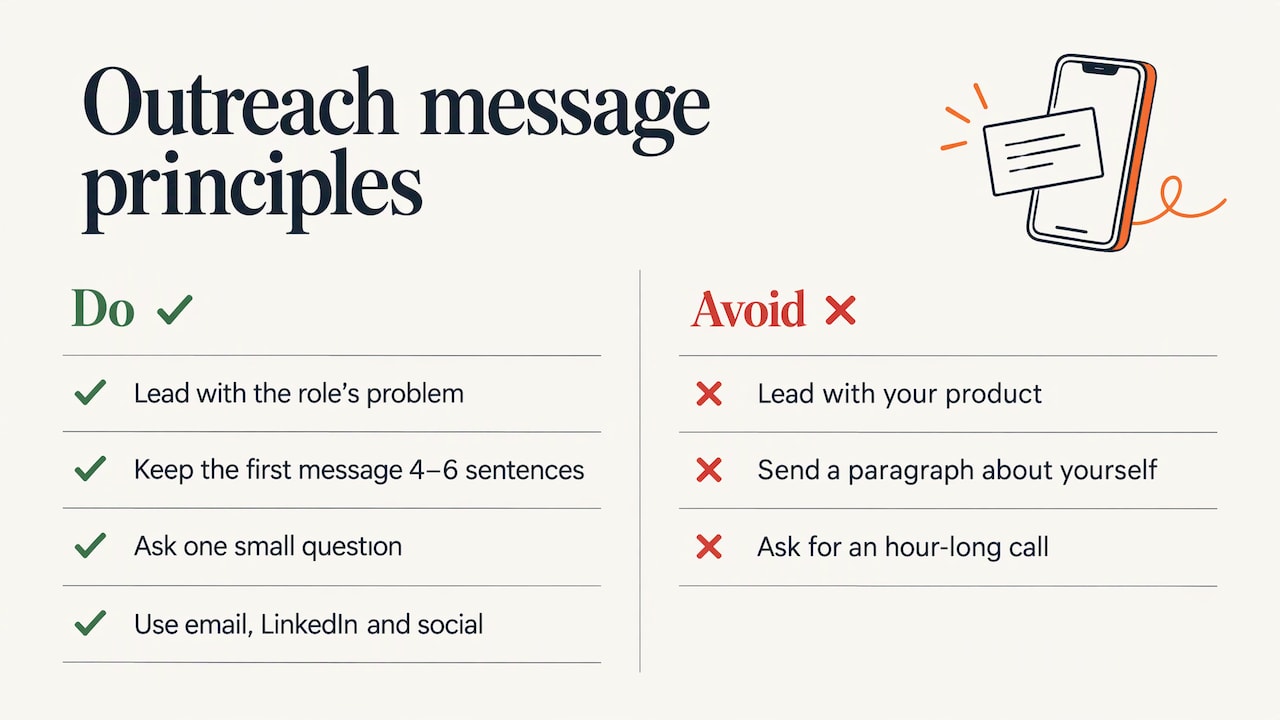
Lead with their problem, not your product. One sentence on a problem that role owns (“most VPs of Operations we speak with are losing hours to manual handoffs between sales and onboarding”) works better than a paragraph about who you are.
Keep it short. Four to six sentences is enough for a first message. Name the problem, give one proof point, and ask one question.
Make the ask small. “Worth a 15-minute call?” or “Want the pricing?” is easier to answer than a request for an hour.
Use more than one channel. A decision maker who ignores email may answer a LinkedIn message. Cold email, LinkedIn and social outreach reinforce each other when the message is consistent. Our LinkedIn outreach strategy and LinkedIn lead generation guide cover connection notes, follow-ups and what to avoid.
Write for the role. A finance ratifier wants terms and risk. A user wants to know it saves them time. A decision maker wants the business case. If you are speaking to a champion, give them language they can forward to their boss.
Content can support all of this. Video and case-study formats that speak to executives’ evaluation criteria, as in these video marketing examples, give a cold message something to point to.
Step 4: Handle the gatekeeper and the multi-threaded account
Executive assistants and operations staff often control access. Treat them as colleagues, not obstacles: be clear about why you are contacting their executive, keep the request specific, and never try to trick your way past them. If a message does not reach the budget owner, a reply from someone else in the group is still progress. Ask who handles the problem, and thank them for the redirect.
When a champion replies, ask who else would need to be involved and offer a short call with both. That is how a single reply becomes a multi-person conversation without you chasing every seat cold.
Step 5: Qualify before you invest sales time
A reply is not a qualified lead. Before a rep spends an hour, confirm four things: the person has authority or influence, there is a problem worth solving, the timing is real, and the budget exists. The HubSpot guide lists 25 qualifying questions, including “Who will be using the product?” and “Which evaluation criteria are the other stakeholders using?” Those two alone tell you whether you are speaking to a decision maker or a messenger.
If you want a formal structure, our comparison of BANT, CHAMP and MEDDIC shows which framework fits which deal size, and how to build a lead scoring model that sales trusts helps you rank the replies you get. Once leads are qualified, good lead routing makes sure the right rep calls within hours, not days.
Step 6: Follow up and measure what matters
Most replies come after the first message. Plan four to six touches over two to three weeks, alternating channels, and give each a new angle: a short proof point, a relevant observation about their company, a simple question. Stop when someone says no or asks you to stop.
Track outcomes in the order that matters to revenue:
| Metric | Why it matters |
|---|---|
| Interested reply rate | Shows whether the message and the role target are right |
| Meetings booked | Shows whether interest turns into time |
| Meetings held with a decision maker | Shows whether you reached the right seat |
| Opportunities created | Shows whether the conversation was real |
| Cost per interested lead | Shows what outreach really costs you |
Opens and clicks are weak signals: opens can be inflated by mail software, and a click is not a buying intention. If a sequence gets opens but no interested replies, the problem is usually the offer or the role target, not the subject line. Our appointment setting process breaks down how to move from reply to booked meeting.
Doing this in-house versus having it run for you
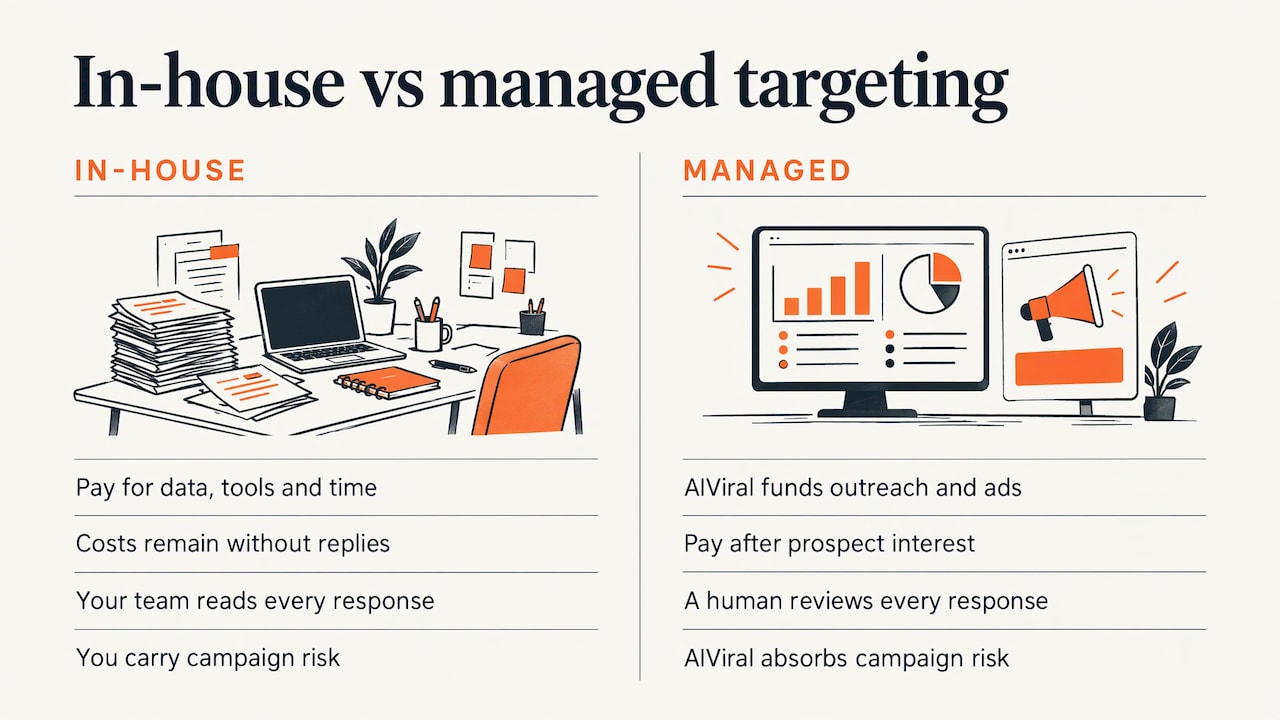
Running decision maker targeting yourself means paying for data, sending infrastructure, outreach tools, copywriting, reply handling and the time of someone who reads every response. You carry that cost whether or not anyone replies, and a slow month still bills.
The managed alternative is to pay for the outcome. With us, all outreach and ad spend is operated and funded by AIViral, not by you, and there are no setup fees, retainers or contracts. That changes who carries the risk: if a campaign targets the wrong role, we absorb the cost, not you.
What we think about decision maker targeting
Most lead generation sells activity: clicks, opens, contacts, “leads” that are a name on a spreadsheet. The buyer then discovers that the person never wanted to talk. We think targeting a decision maker only counts when that person raises a hand.
That is why we built our service around replies. Our AI-driven outreach runs across cold email, LinkedIn, social and search ads, verifies real-time replies from decision-makers, and a human reviews every response before it reaches your dashboard. A lead is delivered only if the prospect asked for a meeting, a call, pricing, information or a demo.
Payment follows interest. You pay between $5 and $50 per lead depending on how strong that interest is, and if a lead does not meet the standard, you can dispute it and get a credit. The outreach, the ad spend and the risk are ours.
The result is that your team’s time goes to conversations with people who asked for them.
Max
Wait, correct signature handling follows.
What you pay for a decision maker conversation
Our pricing follows how interested the prospect is. Each lead is charged once, with no recurring fees:
| Lead level | Price per lead |
|---|---|
| Warm | $5 to $15 |
| Hot | $15 to $30 |
| On fire | $30 to $50 |
You can compare this with your current cost per qualified meeting. Prices are listed on our pricing page, and we also publish industry pages for web and software development, HR and recruitment and commercial real estate.
If you want decision makers who already asked to talk, see how AIViral delivers hot leads. Our service is built for B2B companies, agencies, consultants and SaaS providers.

FAQ
Who is the decision maker in a B2B purchase?
It is the person with final authority and budget, often a senior executive or department head. In smaller companies it can be the founder. Around them sit champions, influencers, users and ratifiers who shape or finalize the deal.
How many people should I contact per account?
Buying groups often include several people, so contact the two or three roles that matter most for your offer rather than a single name or the whole committee. Tailor each message to what that role owns.
How do I contact decision makers without sounding like spam?
Keep the message short, lead with a problem that role has, make a small ask, and follow up on more than one channel. Email must also meet CAN-SPAM requirements in the US, including accurate sender details and honoring opt-outs.
How do I know a lead is really a decision maker?
Ask who uses the product, who else reviews the purchase and what criteria they are using. If the person can approve the spend without checking with anyone, they are the decision maker. If not, they are probably a champion or influencer.
Sources
- Get To Know Your B2B Buying Group, Forrester
- Buying group, PPC Land
- How to Find the Decision Maker and 25 Qualifying Questions, HubSpot
- B2B Buying Committees: How Many Stakeholders in 2024?
- CAN-SPAM Act: A Compliance Guide for Business, FTC
- How to create buyer personas for targeted marketing success
- Video Marketing Examples: 10 Campaigns and What They Teach